
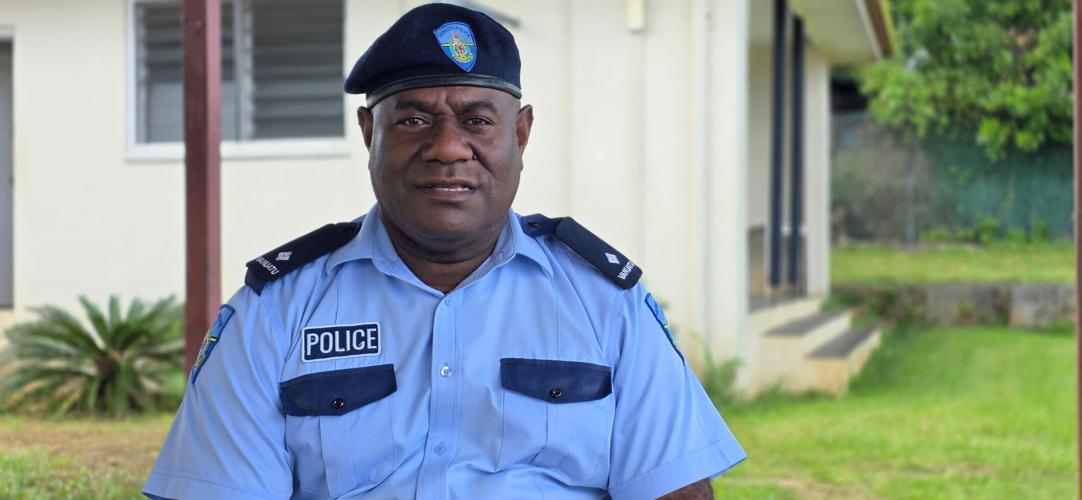
For Inspector Morris Charley, the future of policing in Vanuatu can be summed up in a simple image: a child running towards a police officer instead of away from one. As Deputy Director of the Vanuatu Police Training College (VPTC), he is helping lead efforts to build a police force that children see as protectors they can trust.
That vision contrasts sharply with past approaches to policing, where maintaining law and order often left children overlooked. Many of the country’s most vulnerable citizens saw the police uniform not as a symbol of safety, but as something to fear.
Inspector Charley remembers those days clearly. Early in his career, policing practices often lacked the empathy needed when dealing with children.
“Back then, we enforced law and order on children,” Inspector Charley reflected. “We took them to the station for harsh interviews, and as they grew up, they didn’t see us as friends. They saw the police as the enemy and society as a place without justice.”
This approach was particularly harmful when dealing with cases of domestic and sexual abuse. Unlike adults, children who have experienced trauma often face deep psychological barriers to speaking out.
“A child suffering sexual abuse is carrying a heavy, silent burden,” the inspector explained. “They will not reveal their trauma to a stranger in uniform unless we completely change our approach.”
When the perpetrator lives in the same household, the challenge becomes even greater.
“Our culture emphasises protecting the family, but sometimes that same culture allows horrific crimes to happen inside the home,” Inspector Charley said. “Mothers and children can be silenced by the authority of a father. Only a fraction of these crimes is reported; the rest remain hidden.”
Inspector Charley said this exposes a major gap in the justice system.
“Think about the trauma,” he said. “We put a perpetrator in prison, but the child has to live with the scars for the rest of their life. If the system walks away after the arrest instead of providing a network of care around the survivor, how can they truly heal?”
This is why he believes the Child Protection Bill is urgently needed. It is not just about making arrests; it is about creating a legally mandated, coordinated, multi-agency system focused on a child’s recovery. The Bill would provide a framework to ensure police, child protection officers, healthcare workers and the courts work together to support survivors.
“A dedicated law shifts the focus from simply punishing the crime to actively restoring the child,” Charley said. “It creates a government-backed system where survivors are protected and given the support they need to heal and recover.”
Ultimately, he believes the goal is to transform the relationship between law enforcement and communities over the next decade. With more than 1,000 officers serving across the country, the aim is to ensure every officer is someone children can trust and turn to for protection.
To help achieve this, VPTC is implementing a Training of Trainers (ToT) programme that will eventually be rolled out to frontline police officers across the country, strengthening their ability to work with children in contact with the law.
The college aims to equip police officers with the skills, knowledge and values needed to serve effectively, respond to modern crimes, meet community needs and protect the rights and welfare of all people in Vanuatu, including children.
Inspector Charley has a clear vision of what success will look like.
“In ten years, I want to see a complete transformation of the mindset in Vanuatu,” he said. “When a child sees a police officer walking into their village, they should never run away in fear. I want that child to run towards the officer. I want them to look at the uniform and see a friend, a protector and someone they can trust.”
This vision goes beyond changing procedures or introducing new training programmes. It is about building a culture in which every child knows the police are there not only to enforce the law, but also to protect, support and help them recover when they have been harmed. Inspector Charley added that transformation begins with ensuring that every officer understands the unique needs of children and is equipped to respond with care, professionalism and compassion.
SOURCE: VANUATU DAILY POST


