
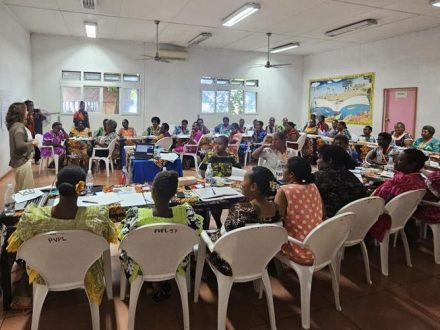
The Ministry of Education and Training (MoET), in partnership with UNICEF and World Vision, successfully conducted a two-day training on Early Childhood Care and Education (ECCE) in Emergencies in SHEFA Province. The training, financed by the European Union (EU)-funded Climate Resilient Sheltering Schools (CRSS) Project, focused on building the capacity of ECCE teachers to support children’s wellbeing, learning, and resilience during disasters and emergencies.
The training brought together 46 ECCE teachers from schools across SHEFA Province. Participants engaged in sessions on child development, psychosocial support, inclusive education, and disaster preparedness – all delivered through participatory learning approaches designed to help children learn and recover in safe, nurturing environments.
Speaking at the opening, Mr. Gabor Sasvari, the EU Programme Manager for the Pacific Adaptation to Climate Change and Resilience Building Project, noted the importance of collaboration in ensuring every child in Vanuatu can learn, grow, and thrive, even in times of crisis.
“This two-day training is part of our shared commitment to ensure that every child, from the earliest years, can learn, grow, and thrive, even in challenging circumstances,” said Mr. Sasvari. “Through the Climate Resilient Sheltering Schools programme, the EU, UNICEF, MoET, and World Vision are working together to make schools safer, more inclusive, and resilient communities.”
Resilience begins early. When disruptions occur, the youngest learners are often most affected. Strengthening the skills of ECCE teachers ensures that children are protected while also being supported to adapt and recover during emergencies.
The Climate Resilient Sheltering Schools Project, implemented by UNICEF with MoET and supported by the European Union, aims to ensure that education in Vanuatu is safe, inclusive, and climate resilient. The initiative focuses on both physical improvements – such as strengthening school infrastructure – and human capacity development, by empowering teachers with essential skills.
“Teachers are the heart of every resilient education system,” Mr. Sasvari said. “With the right tools and training, ECCE teachers can turn difficult moments into opportunities for children to grow stronger, learn coping skills, and continue to develop their full potential.”
The MoET commended the ongoing partnership with UNICEF, World Vision, and the European Union for their continued efforts in building Vanuatu’s resilience through education. By investing in early learning and teacher development, the partnership strengthens the foundation for lifelong learning and ensures that schools remain safe spaces for all children.
The Ministry, in collaboration with communities, schools, and development partners, reaffirms its commitment to delivering the priorities outlined in the Vanuatu National Sustainable Development Plan 2016 to 2030, the United Nations Convention on the Rights of Persons with Disabilities, and the United Nations 2030 Agenda for Sustainable Development. This commitment reflects the collective effort to continually improve access, quality, and management within the Vanuatu education system.
SOURCE: VANUATU DAILY POST


