
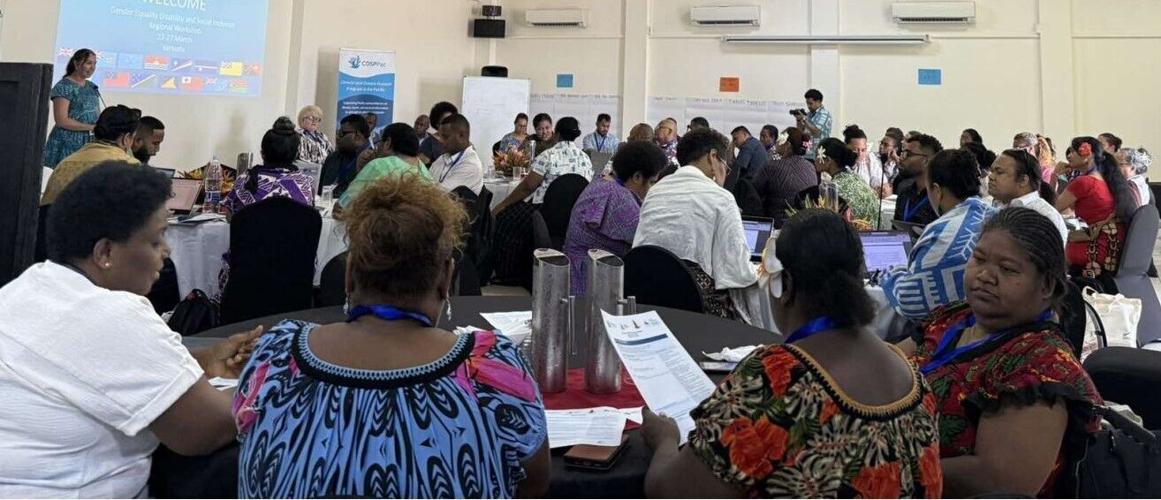
A regional Gender, Disability and Social Inclusion (GEDSI) Workshop is underway in Port Vila, bringing together meteorological focal points from across the Pacific to strengthen inclusive weather and climate services.
The workshop gathers representatives from National Meteorological and Hydrological Services, including the Vanuatu Meteorology and Geo-Hazards Department, the Pacific Disability Forum and other Organisations of Persons with Disabilities (OPDs).
Pacific communities continue to face increasing climate and disaster risks, yet access to weather and climate information remains uneven. Vulnerable groups, including persons with disabilities, older people, remote island communities and those with limited literacy or connectivity, often face barriers in receiving and understanding critical information.
Regional Director of the Melanesia Office at the Pacific Community, Sarah Mecartney, said gender equality, disability and social inclusion are institutional performance standards for meteorological services,
Ms Mecartney stressed that inclusion must be embedded across all services, from observation and product design to dissemination and stakeholder engagement, as well as in governance structures and partnerships.
“When inclusion is institutionalised, service relevance strengthens, uptake improves and blind spots are reduced,” she said.
She added that the workshop reflects a shift from consultation to co-design, where communities are engaged as partners and experts in shaping inclusive systems.
Director of VMGD, Levu Antfalo, said the workshop brings together meteorological focal points from across the Pacific, with a focus on gender equality and inclusion of people with special needs.
He said the aim of the week-long workshop is to address gaps in how meteorological information is communicated.
“If information is released and people do not understand it, then our work is incomplete. If people cannot hear or access the information, then we have not fulfilled our responsibility,” he said.
Mr Antfalo acknowledged that challenges remain in reaching all communities, including limitations related to disability inclusion, gender considerations, telecommunications access and the technical language used in weather information.
He said the workshop seeks to identify practical solutions to ensure that messages are clearly understood and enable people to take action to protect lives.
“This week, we are sharing experiences from across the Pacific to see what works in different countries and how those approaches can be adapted to improve services,” he said.
He added that improving clarity and accessibility of meteorological bulletins is essential.
“If people receive information but cannot act on it, then our work becomes meaningless,” Antfalo said.
First Secretary of the Ministry of Foreign Affairs and Trade, Holly Peacock, said inclusive weather and climate services must be designed intentionally.
“That is why it is so important that we work together to ensure weather and climate services are inclusive by design, not by exception,” she said.
Ms Peacock noted that while progress has been made, challenges remain, particularly due to limited resources and inconsistent approaches across the region.
She said the workshop builds on momentum from the previous regional GEDSI workshop and the establishment of a GEDSI Focal Point Network, aiming to move from commitments to practical implementation.
Over the coming days, participants will work with practical tools and contribute to the development of a Regional GEDSI Practice Framework, which will set minimum standards and highlight best practices across the Pacific.
“Our hope is that within the coming months, each national meteorological service will implement at least two concrete improvements to make services more inclusive,” she said.
Ms Peacock also emphasised the importance of strengthening partnerships with disability organisations, women’s groups, youth networks and community-based organisations.
She encouraged participants to actively engage in the workshop, share experiences and build connections.
“I look forward to seeing practical improvements that will make a real difference to families and communities across our region,” she said, adding that New Zealand remains committed to supporting the initiative.
The workshop is convened by SPC through the Climate and Oceans Support Program in the Pacific (COSPPac), hosted by VMGD, and delivered in collaboration with regional partners, marking a significant step toward more inclusive and accessible meteorological services in the Pacific.
SOURCE: VANUATU DAILY POST


