
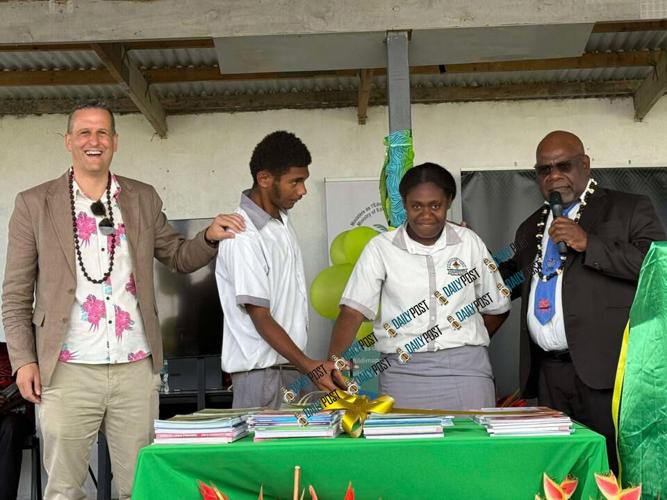
The Government of Vanuatu and the Government of New Zealand have launched Impruvum Sekendri Edukesen, a VT1.9 billion (NZ$16.5 million) partnership aimed at improving secondary education and expanding learning opportunities for young people across Vanuatu.
The programme was officially launched at Vila North School by Minister of Education and Training Simil Johnson and New Zealand High Commissioner to Vanuatu Peter Kemp.
It supports the Ministry of Education and Training’s vision of providing all learners with access to quality, equitable education that prepares them for further study, employment and participation in national development.
One of the programme’s key achievements has been the redevelopment and rollout of Vanuatu’s junior secondary curriculum for Years 7 to 10. The outcomes-based curriculum is tailored to the Vanuatu context and incorporates Pacific-relevant 21st-century skills and knowledge.
A network of 15 teacher mentors is supporting teachers across all six provinces to improve classroom practices and student engagement.
An instructional leadership programme for school leaders and principals has also contributed to improvements in 32 secondary schools on Efate, with plans to expand the initiative to the provinces next year.
The programme is delivered by Cognition Education in partnership with the Ministry. Partners also acknowledged Tetra Tech International’s earlier contribution to the curriculum redevelopment.
{h4}Investment in young people{/h4}
Speaking at the launch, Minister Johnson said education was fundamental to Vanuatu’s future and that investing in young people was essential to national development.
“Without education, there will be no future. We need to build a strong foundation so the future of our country can move forward,” he said.
He said that while infrastructure such as buildings and hospitals was important, people needed the knowledge and skills to manage and maintain these facilities effectively.
The Minister said quality education would help prepare children to become future leaders who could think critically, solve problems and contribute to their families, communities and the nation.
He said the Government wanted everyone in Vanuatu to have access to quality education and the opportunity to reach their full potential.
While access to primary education had improved, he said secondary schools also needed suitable learning environments to support students.
Minister Johnson thanked New Zealand for its continued partnership and support for the education sector. He said the programme would strengthen the curriculum, improve learning resources and support teaching and learning from kindergarten to Year 10.
He also acknowledged Australia and other development partners, as well as the schools, teachers and stakeholders contributing to education reforms.
{h4}School leadership and teacher support{/h4}
Principal of Vila North School Dorina Lala Sam welcomed the programme and acknowledged the dedication of the school’s teaching staff and school council.
She said their support and leadership had helped improve learning outcomes and provide quality educational opportunities for students.
Sam said the launch was particularly meaningful to her as both a school principal and a former recipient of opportunities that had shaped her own education.
She is an alumna of the New Zealand Manaaki Scholarship Programme, which she said had helped her develop personally and contribute to the education sector and her community.
Her experience had shown her the lasting impact of education and strong support systems on learners and teachers.
Sam said she had taken part in professional development workshops under the secondary education programme, strengthening her understanding of school leadership and how it can improve teaching and learning.
She is now implementing changes at Vila North School to strengthen instructional practices, better support teachers and improve student outcomes.
These changes are helping create a more collaborative, learner-centred environment, she said.
Sam also acknowledged the professional development and mentoring provided by subject mentors, saying the support had increased teachers’ confidence, improved lesson delivery and helped them provide more engaging learning experiences.
She described the programme as an investment in Vanuatu’s young people and thanked its partners, mentors, facilitators and others supporting education.
She encouraged students to make the most of their opportunities and prepare to contribute to the country’s future.
New Zealand reaffirms education partnership
High Commissioner Kemp said the launch celebrated the potential of Vanuatu’s young people and the two countries’ shared commitment to giving them the knowledge, skills and opportunities to build their futures.
He said visits to schools had inspired him through students’ ambitions to become teachers, nurses, engineers, business leaders and other contributors to Vanuatu.
“A good education is one of the most powerful tools for turning those dreams into reality,” he said.
Kemp said New Zealand was proud to partner with the Government of Vanuatu through a relationship built on friendship, trust and a shared commitment to creating opportunities for the next generation.
He said the programme supported those at the heart of education, including teachers, principals, deputy principals and students.
It provides practical mentoring and classroom guidance for teachers, strengthens school leadership, improves curriculum resources and supports students who need additional help with reading, writing and numeracy.
Kemp acknowledged Cognition Education as the implementing partner and said the programme was designed to support Vanuatu’s education priorities rather than impose outside solutions.
He said the partnership aimed to strengthen the systems, leaders and teachers already working to improve young people’s lives.
SOURCE: VANUATU DAILY POST


