
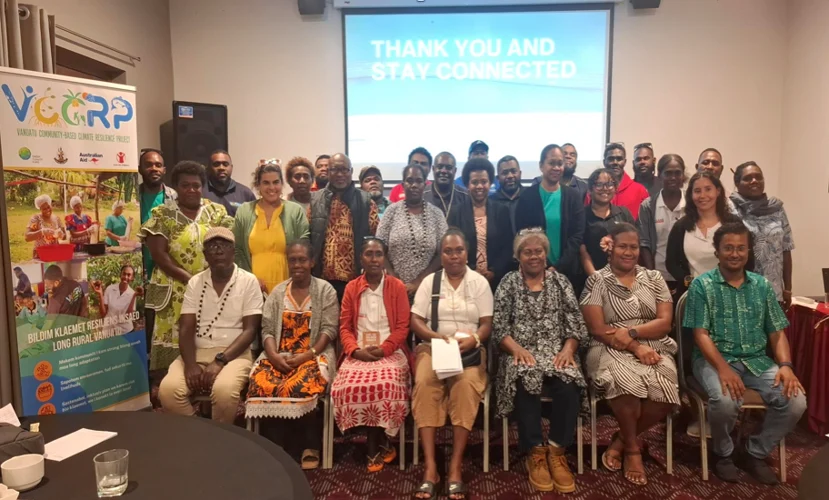
The Solomon Islands Knowledge–Action–Sustainability for Resilient Villages (SOLKAS) Project and the Vanuatu Community Based Climate Resilience Project (VCCRP) have reinforced their commitment to locally led climate adaptation through a regional knowledge exchange held in Port Vila alongside the Pacific Innovation Forum on Climate and Environment (PIFCE).
The knowledge exchange workshops brought together community representatives, government partners, and project teams to share experiences in disaster risk reduction, climate information systems, food security, resilient livelihoods, ecosystem restoration, and conservation. Both projects are supporting communities to lead their own adaptation and resilience efforts.
VCCRP Team Lead, Mrs. Vomboe Molly Shem, emphasised the shared vision across nations. “Although we come from different island nations, we share a common purpose — to serve our communities. At the heart of both SOLKAS and VCCRP are the people we work with. Through community adaptation plans, youth engagement, and the stories shared by our communities, we are reminded that locally led adaptation is not just a concept — it is a necessity. By listening to local voices and learning from one another, we can build stronger, more resilient communities for the future.”
Building on these discussions, participants explored the eight Principles of Locally Led Adaptation through storytelling and interactive dialogues. They highlighted the importance of inclusive participation, community ownership, and ensuring that traditional knowledge contributes to climate risk-informed planning.
They also emphasised the need for bottom-up approaches starting with community-based adaptation plans informing area, provincial, and national climate resilience strategies.
While acknowledging similarities in culture and traditional systems, participants also agreed that investing in local leadership and governance structures, shifting decision-making power to communities, and adopting flexible programme approaches are essential for sustainable climate resilience.
Mr. Silas Laulifia, Fisheries Officer from Makira Province in the Solomon Islands, reflected on the key takeaways from the discussion and shared that both projects are similar in focusing on community-led initiatives but different due to government planning structures. He said, “Working with local committees is essential for climate resilience, but for sustainability they need to be strengthened and registered so they are recognised and can access funding after the project ends.”
The knowledge exchange concluded with a shared commitment to strengthening regional partnerships, promoting continuous learning, and placing communities at the centre of climate adaptation.
The collaboration demonstrates the value of Pacific countries working together to share knowledge, reinforce locally led solutions, and build more resilient communities in the face of climate change.
The knowledge exchange was made possible through the Government of Vanuatu and the Ministry of Climate Change hosting the inaugural PIFCE. Both SOLKAS and VCCRP look forward to the next PIFCE being hosted in Port Vila in 2028, allowing an opportunity to reflect on best practices and successful models that can be replicated in locally led adaptation across the Pacific and globally.
SOLKAS is funded by the Green Climate Fund (GCF) with the support of the Governments of Solomon Islands, Australia and New Zealand, and Save the Children Australia.
VCCRP is funded by the GCF with the support of the Governments of Vanuatu and Australia, and Save the Children Australia.
SOURCE: VANUATU DAILY POST


